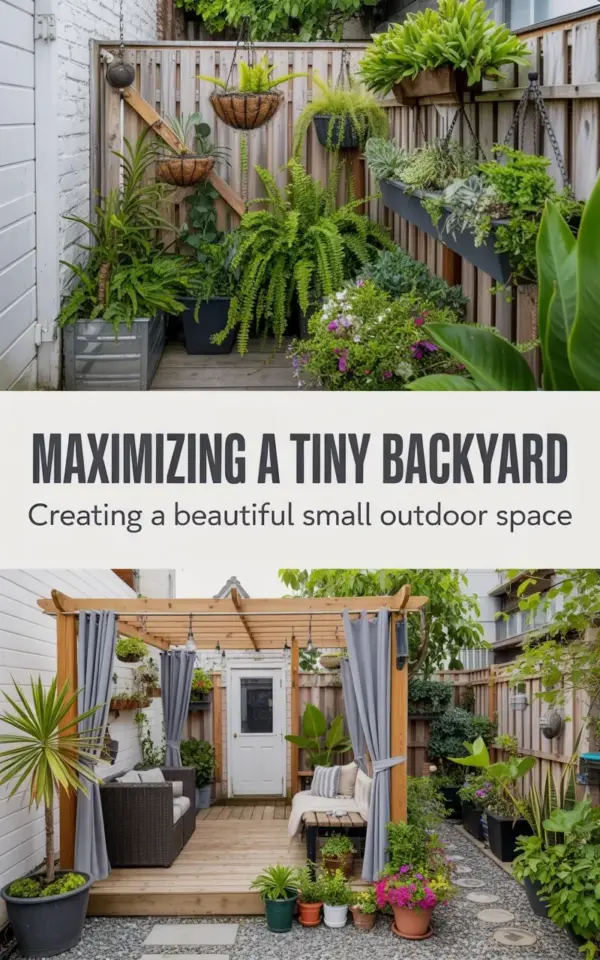
Your neighbor’s grill is staring at you. Again. You’ve got maybe ten feet of concrete and a patch of sad-looking grass, and honestly, you’re tired of treating it like a storage unit for your recycling bins. I get it. You want a place to drink your coffee outside without feeling like you’re sitting in a parking lot. You can do that. It’s not about square footage; it’s about making every inch work double-duty.
This little transformation uses two big moves: a vertical planter wall for greenery and a pergola with curtains to create a room where there wasn’t one. It’s a weekend project that changes how you live in your own home. And before you say “but my yard is too small,” look at the photo. That wooden fence and those hanging ferns? That’s a jungle vibe packed into a space smaller than your living room. Let’s break down how to steal this look.
Build a Privacy Fence That Does More Than Block Sightlines
A fence in a small yard isn’t just a boundary. It’s the backdrop for everything else you’re going to do. The problem is, a standard flat fence in a tiny space can feel like a prison wall. The fix here is adding texture and weight with hanging planters directly on the wood. This isn’t just about privacy from your neighbor; it’s about creating a lush, layered wall that draws your eye upward.
When you mount planters on the fence, you free up all your ground space for furniture and foot traffic. That’s the secret. Use heavy-duty brackets, not just nails, because a wet fern is heavier than you think. I speak from experience. I lost a perfectly good ceramic pot and a lot of soil on a windy Tuesday because I got lazy with the hardware. Don’t be me.
Here’s a quick list for fence mounting:
- Always use galvanized screws and wall anchors rated for the weight of wet soil.
- Rotate your pots every week so all sides of the plants get sun and stay bushy.
- Choose plastic or resin planters for hanging to reduce the load on the fence structure.
- Hook a rain chain or a small gutter spout near the fence to collect water for your plants.
- Install a drip tray system, or you’ll get ugly mineral streaks on the wood.
The Vertical Garden Strategy for a Tiny Backyard
You’re looking at that photo and thinking, “ok so, the plants are stacked on top of each other.” That’s the point. A vertical garden isn’t a trend, it’s basically the only logical way to garden when you don’t have lawn space. Instead of spreading out, you stack. The eye reads height as volume, so a wall full of trailing plants makes the yard feel bigger and lusher than it actually is.
Mix your foliage textures. You need some spikey ferns, some broad leaves, and something that trails down over the pot edge. The green in the photo is doing exactly that. It’s a mix of deep greens and lime greens. To pull this off, choose shade-tolerant plants if your fence is against a wall. Ferns, Japanese forest grass, and trailing golden pothos thrive in partial sun. In full sun, go with creeping jenny and herbs.
And here’s the thing: the planters themselves matter almost as much as the plants. Dark metal or dark wood planters disappear into the fence background, making the foliage pop. Light-colored planters draw attention to themselves. Sure, use them, but only if you want a crisper, more curated look. I prefer the “green explosion” approach where the containers just vanish.
Build a Pergola With Curtains To Create an Outdoor Room
This is the “before and after” moment. A pergola adds height and structure, but what really works in a small space is the curtains. Gray drapes hanging from the posts do two things. They soften the harsh sun, casting that nice dappled glow, and they define the space as a separate room. You’re basically installing a physical barrier between your coffee and the chaos of the world.
For a tiny yard, don’t build a pergola that covers the whole area. You want it just big enough to shade a small seating set. You might not even need to build one. I’ve seen people use a flat metal pergola kit from the hardware store, which takes the guesswork out of load-bearing. Unless you are a very confident builder, kits are the way to go. Building something structurally sound from scratch that holds heavy curtains is harder than it looks.
The curtains themselves should be outdoor-rated or even those plastic shower-curtain-like panels if you live in a rainy climate. Nobody wants to take fabric down every time it drizzles. Pull them completely closed to hide a utility shed or an AC unit, or tie them back to frame a view. It’ versatility, pure and simple.
Fix the Ground: Patio Solutions for Dirt and Concrete
Let me guess what’s underfoot. Green concrete, mud, or the remnants of an old patio that was uneven from day one. You notice the ground more in a tiny backyard because you’re always standing on it. You want to stain, tile, or lay deck tiles over it. The black or dark brown tiling in the photo looks clean and modern. It also gives the space that seamless indoor-outdoor feel.
This is the part of the project that isn’t as glamorous as the plants, but trust me, it matters. If you have dirt, lay down a good weed barrier cloth and pour gravel or pea pebbles. It’s cheap and drains well. If you have concrete, cover it with those interlocking wood deck tiles. You can literally just click them together in an afternoon. There is no excuse to leave it raw. A muddy floor ruins the new furniture vibe instantly.
Lighting, Ambiance, and Final DIY Touches
String lights are the obvious answer. But this year, look for lanterns or spotlights that you can angle up into the plants. Lighting creates shadows, and shadows add layers to a small space. You can hang a simple lantern chain from the pergola beam horizontally. That will make the ceiling look higher than it is.
One thing people overlook is the scent. Grow mint or lavender in a small planter right next to your seating area. You don’t even need to touch it. Just the breeze hitting the leaves is enough to smell something nice. That’s the kind of subtle, specific detail that makes a backyard feel thoughtful. It’s not just visual. Anyway, aim for a mix of warm white lights: the warm yellow kind, not the harsh strobe-like white. You want your tiny patio to look like a bar, not a warehouse.
Seasonal Swaps and Maintenance That Keep the Yard Alive
Don’t plant permanent stuff if you like variety. Use pots. This makes the entire yard modular. When spring comes, throw in some pansies. When summer hits, swap them for tropical vines. In the fall, you can wire in some pumpkins and gourds to the fence without changing the structure. It keeps the decor fresh without buying a new yard.
Winter is the real test. All those ferns in the photo? They will die when frost comes. Not gonna lie, it hurts a little to watch. Keep the hardscape (the pergola and fence) strong. Replace dead foliage with dried grasses and evergreen boughs. That way, the greige curtain color pops against the winter white.
To make your life easier, invest in a long watering wand. Reaching those top planters every day is a pain, and a step ladder gets old fast. Also, check the curtain rings for rust every couple of months. It’s a tiny job, but ignoring it means replacing the whole rod eventually.
So stop looking at that empty patch of dirt and start building. Is it work? Yes. But it’s the kind of work that leads to you sitting outside with a drink at 6 PM, listening to the rustling leaves, completely hidden from the street. That is the goal. Now go buy some ferns and get to it.
Leave a Comment