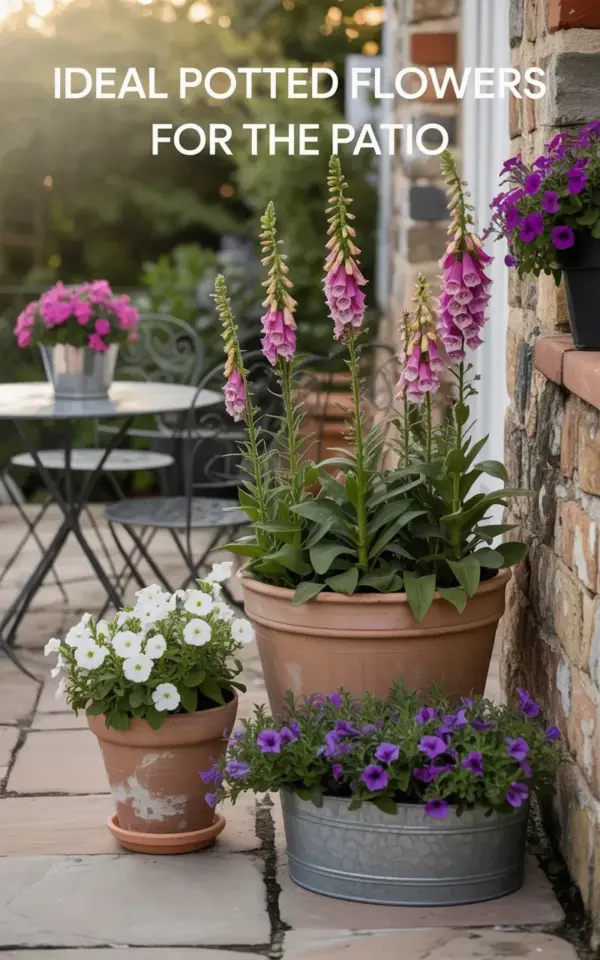
There’s a way to make a patio feel alive that has nothing to do with expensive furniture or string lights. It’s the little cluster of pots, sitting against an old stone wall, doing the heavy lifting. Look at the photo this post is built around: a terracotta centerpiece holding tall pink foxgloves, flanked by white petunias in a smaller clay pot and a gray metal planter where purple petunias spill over the edge. These potted flowers for the patio are proof that you don’t need a yard to get that full, lush summer garden look.
The whole scene just works, and honestly, it’s simpler to recreate than you think. If you’ve never planted a container garden because you’re worried you’ll kill everything or you don’t know where to start, this one’s for you. I’m going to walk you through exactly what’s in this setup, why it works, and how to do it yourself even if your gardening knowledge is currently sitting at zero.
Why Foxgloves Make the Perfect Patio Garden Centerpiece
Foxgloves are the tall, dramatic spires in the middle of that big terracotta pot. Their scientific name is *Digitalis*, but you don’t need to remember that to grow them. You just need to know that they give you vertical height that most summer flowers simply can’t match. In the photo, those pink foxgloves are the first thing your eye lands on, and that’s by design.
They’re technically biennials, which means in some climates they grow leaves the first year and flower the second. But here’s a secret: nurseries almost always sell them already blooming in spring, so you get the flowers right away. Plant them in a spot that gets partial sun to full sun, and they’re surprisingly tough. One thing to remember: every part of the foxglove is toxic if eaten, so skip them if you have dogs or cats that like to taste-test your plants.
Pairing Petunias With Foxgloves for a Summer Container Garden
The genius of this arrangement is the contrast. Those foxgloves shoot straight up, but they don’t do much for the sides of the pot. That’s where the petunias come in. On the left, you have white petunias filling out a smaller clay pot. On the right, purple petunias are cascading over the edge of a gray metal planter, softening all those hard lines.
You want a mix of thrillers, fillers, and spillers in any good container garden. The foxglove is your thriller, the bushy petunia plants are the fillers, and the trailing habit of the petunias makes them natural spillers. Petunias are also ridiculously easy to care for. They don’t demand much, just regular water and occasional feeding, and they’ll pump out blooms all summer long without complaint.
How to Arrange Potted Flowers Against a Stone Wall
There’s a reason the stone wall in the photo matters so much. It creates a neutral backdrop that makes the pink, white, and purple colors pop. The weathered texture of the wall also contrasts beautifully with the smooth petals of the flowers. When you’re arranging your own pots, think about what’s behind them. A plain fence, a brick wall, even the side of your house all work, as long as the color doesn’t clash with your blooms.
Play with different container sizes and heights, too. Notice how the largest pot is in the center, with smaller ones on either side. That little bit of asymmetry keeps things interesting. If you put all your pots in a straight line, all the same size, it reads more like a display shelf than a garden. Group them in odd numbers, vary the heights, and let the plants mingle slightly as they grow.
The Best Containers for a Summer Planter Display
In the photo, you see two terracotta pots and one gray metal planter. This mix of materials is a smart move because it looks collected over time, not bought from a catalog in one afternoon. Terracotta is classic and breathable, which is great for roots, but it dries out fast in the summer heat. The metal planter holds moisture longer, but it can get quite hot in direct sun.
Whichever containers you choose, you absolutely must have drainage holes. This is non-negotiable. If water can’t escape the bottom, your plant roots will rot. Also, think about the weight of the pot if you’re putting it on a patio or balcony. That big terracotta pot in the middle looks fantastic, but it’s heavy as hell once it’s filled with damp soil. If you have to move things for winter, maybe go with a lightweight faux ceramic pot that looks like the real deal.
Easy Steps for Beginners to Plant a Patio Garden
Okay, let’s get down to the actual planting process because it’s much less scary than it seems. You need your pots, some good quality potting mix, and your plants. Grab a bag of slow-release fertilizer while you’re at the store, too, and mix it into the soil before you plant anything.
– Fill your pot about two-thirds full with potting mix.
– Gently pop the foxglove out of its nursery container and loosen the roots with your fingers.
– Place it in the center of the big pot, then add more soil around the sides.
– Press the soil down firmly to remove any air pockets, but don’t bury the crown of the plant.
– Water slowly until you see water coming out the bottom.
For the petunias, you can follow the same process but tuck them closer to the edges so they can trail over the rim. If you want a fuller look, don’t be afraid to cram a few petunia plants into one pot. They actually seem to like the company, and it gives you that overflowing, lush vibe immediately.
Keeping Your Summer Flowers Blooming All Season
Deadheading is the boring chore that actually pays off. Petunias especially need their old, faded flowers pinched off to keep producing new ones. This is not optional, not if you want the kind of nonstop color you see in the photo. Spend five minutes every few days pinching off the spent blooms. Foxgloves, on the other hand, will bloom from the bottom up. Once the whole spire is done, you cut the stalk down to the growing point.
Watering is where most people go wrong. They either drown the plants or forget them for a week. Stick your finger into the soil about an inch deep. If it’s dry, water it. If it’s damp, wait a day. During the hottest part of summer, you might need to water these pots every single day. Mulch on top of the soil helps hold moisture in, and it looks tidy, too.
There’s also the matter of feeding. Slow-release fertilizer in the soil at planting time is a great baseline, but by mid-July, those nutrients run out. A liquid feed every couple of weeks will keep the petunias vigorous and the foxgloves towering. Honestly, it makes the difference between a so-so display and a gorgeous one.
Final Thoughts and a Nudge to Start Your Own Container Garden
Putting together a container garden like the one in the photo really is as simple as choosing the right plants and giving them a good home. Start with one big focal plant you love, add a couple of fillers or spillers, and don’t overthink the rest. The stone wall helps, but your porch railing or balcony ledge can look just as inviting with the right mix of pots.
Let the imperfect parts be okay. Maybe your foxgloves lean a little, or your petunias don’t spill exactly where you wanted them to. That’s what a real summer garden looks like. Now go grab some potting soil and make your patio the spot everyone wants to hang out this year. Got a south-facing spot that bakes all day? Tell me what you’re thinking about planting there.
Leave a Comment